
Tarrant County is one of the most populated counties in Texas and serves as a center for county government, public administration, courts, and official services. Residents, property owners, businesses, and visitors rely on its county offices for a wide range of public information and government functions. From court systems and public records to property services and local departments, the county manages many essential responsibilities. This website brings together those resources in one organized location to help users find reliable county information more easily. Each section highlights an important county service and connects visitors with dedicated pages for more detailed information. The goal is to make county resources easier to locate without searching across multiple sources.

Tarrant County, TX offers many public services through its government departments, including courts, county offices, property administration, public records, law enforcement, elections, and vital records. This website serves as a central resource covering the county’s most requested services while helping users understand which office manages each responsibility. Visitors can browse information related to court records, property records, marriage records, jail services, tax offices, and other official county departments. Every topic is organized into its own page to provide clear information while keeping navigation simple. Whether someone needs general county information or wants to locate a specific government office, this website provides a convenient starting point for exploring Tarrant County Texas services and resources.
Population, History & Government
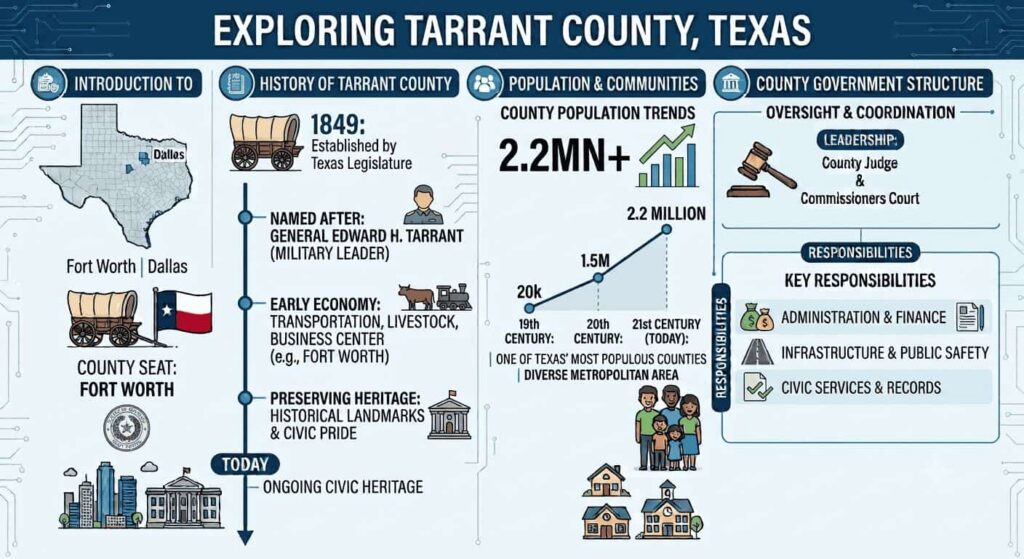
Tarrant County is one of the largest counties in North Texas, serving millions of residents through an established system of county administration and public services. With Fort Worth as the county seat, the county plays an important role in the Dallas–Fort Worth metropolitan area by supporting local government, business growth, transportation, and community development. The following sections provide a brief overview of the county’s history, population, and government structure before introducing the services covered throughout this website.
History of Tarrant County
Tarrant County was established in 1849 by the Texas Legislature during a period of rapid settlement across the state. The county was named after General Edward H. Tarrant, a military leader and frontiersman who served the Republic of Texas. Over time, Fort Worth developed into an important transportation, livestock, and business center, helping the county become one of the leading economic regions in Texas. Today, the county continues to support a growing population while preserving its historical landmarks and civic heritage.
Population & Communities
With more than 2.2 million residents, Tarrant County ranks among the most populous counties in Texas. Continued population growth has supported the expansion of housing, education, healthcare, transportation, and local businesses across the region. The county serves a diverse metropolitan area made up of large cities and rapidly growing suburban communities.
Major communities served include:
- Fort Worth (County Seat)
- Arlington
- Grapevine
- Mansfield
- North Richland Hills
- Bedford
- Euless
- Hurst
- Keller
- Southlake
These communities contribute to the county’s strong economy and create ongoing demand for reliable public services and county resources.
County Government
The Tarrant County Government oversees county administration and coordinates many public services used by residents and businesses. Leadership is provided by the County Judge and the Commissioners Court, which establish county policies, approve budgets, and oversee county operations. Working alongside elected officials and government departments, they help manage county resources and support local communities.
County government is responsible for:
- Public administration and county operations
- Budget planning and financial management
- Community programs and county resources
- Infrastructure planning and maintenance
- Emergency management and public safety coordination
Many county departments work together to deliver these civic services. Detailed information about courts, public records, property services, elections, law enforcement, and other government offices is available in the dedicated sections throughout this website.
Tarrant County Public Records
Tarrant County Public Records include many types of government records that help residents, businesses, researchers, and legal professionals find official information maintained by county offices. These records support transparency by allowing public access to information that is available under state laws, while some records may remain restricted to protect privacy or comply with legal requirements. This section introduces the most commonly requested record categories and directs visitors to dedicated pages for more detailed information.
Public records include a wide range of official records created or maintained by county departments during daily government operations. These may include court filings, property information, vital records, and other government records that are available through the appropriate county office. Each record type follows its own rules for availability and record requests.
Court Records
Court records contain information related to civil, criminal, family, probate, and other court proceedings handled within the county’s judicial system. These public documents may include case filings, hearing details, judgments, and court orders, depending on public availability and court policies.
Property Records
Property records provide information about land ownership, deeds, parcel details, property assessments, and other real estate information maintained by county agencies. These official records are commonly used during property research, ownership verification, tax planning, and real estate transactions.
Arrest Records
Arrest records document law enforcement actions involving individuals who have been taken into custody. Depending on legal restrictions and public access rules, available information may include booking details, arrest dates, charges, and related records maintained by the appropriate agency.
Vital Records
Vital records include important life-event documents such as birth records, death records, marriage records, and divorce records. These government records are maintained by authorized offices, and eligibility to obtain certified copies may vary based on state laws and record request requirements.
Tarrant County Courts
Tarrant County Courts are part of the county’s judicial system and handle a broad range of legal matters for residents, businesses, and visitors. Different court divisions hear different case types, helping the county manage legal proceedings fairly and efficiently. Whether a case involves criminal charges, civil disputes, family matters, probate issues, or local ordinance violations, each court has its own jurisdiction and responsibilities. The sections below provide a brief introduction to the major court divisions, with links to dedicated pages that explain each topic in greater detail.
District Court
The District Court hears many of the county’s most significant legal cases. These courts have broad jurisdiction and handle matters assigned under Texas law.
Common case types include:
- Felony criminal cases
- Major civil lawsuits
- Family law matters
- Juvenile proceedings (in designated courts)
Criminal Court
The Criminal Court focuses on criminal offenses handled within the county’s judicial system. Depending on the court, cases may involve misdemeanor or felony charges and move through several stages before reaching a final resolution.
Typical responsibilities include:
- Criminal hearings
- Arraignments
- Jury and bench trials
- Sentencing proceedings
Civil Court
The Civil Court resolves disputes between parties without involving criminal charges. These courts review evidence, hear legal arguments, and issue decisions based on applicable laws.
Civil matters often include:
- Contract disputes
- Property disagreements
- Personal injury claims
- Financial and business disputes
Family Court
The Family Court manages legal matters involving family relationships and domestic issues. The court works with cases that require legal decisions affecting parents, children, and other family members.
Common proceedings include:
- Divorce
- Child custody
- Child support
- Adoption
- Protective orders
Probate Court
The Probate Court handles legal matters involving estates, guardianships, trusts, and wills. Some probate courts may hear additional matters assigned under state law.
These courts commonly oversee:
- Estate administration
- Probate of wills
- Guardianship cases
- Trust-related proceedings
Municipal Court
The Municipal Court hears cases involving city ordinance violations and traffic-related offenses that occur within municipal boundaries. Each municipality operates its own court and follows local procedures.
Cases may involve:
- Traffic citations
- Parking violations
- Class C misdemeanors
- City ordinance violations
Juvenile Court
The Juvenile Court handles cases involving minors and follows laws that focus on accountability, rehabilitation, and the well-being of young people. Proceedings are handled differently from adult criminal cases.
This court commonly addresses:
- Juvenile delinquency
- Status offenses
- Child protection matters
- Court-supervised rehabilitation
Justice of the Peace Court
The Justice of the Peace Court serves local communities by handling smaller legal matters and certain civil and criminal proceedings. Multiple precinct courts operate across Tarrant County.
Common case types include:
- Small claims cases
- Evictions
- Landlord-tenant disputes
- Truancy matters
Court Calendar
The Court Calendar displays scheduled hearings and upcoming court sessions across different court divisions. Dates and courtroom assignments may change based on court schedules.
Users often review the calendar to find:
- Hearing dates
- Court sessions
- Scheduled appearances
- Upcoming proceedings
Court Docket
The Court Docket provides information about scheduled cases and courtroom activity. It helps attorneys, litigants, and members of the public review upcoming legal proceedings and case scheduling.
A court docket may include:
- Case numbers
- Hearing schedules
- Courtroom assignments
- Filing activity
- Case status updates
Property Records & Tax Services
Tarrant County Property Records provide official information about real estate ownership, land records, property values, and tax-related services maintained by county offices. Whether someone is researching a property, confirming ownership details, or reviewing tax information, these records support a variety of personal, legal, and financial needs. Different county departments manage specific property services, making it helpful to know which office handles each type of record. The sections below introduce the primary property-related resources available throughout Tarrant County and link to dedicated pages with more detailed information.
Property Records
Property Records contain official information about real estate within the county. These records help verify property ownership, recorded deeds, legal descriptions, and other land-related information maintained by the appropriate office. Buyers, property owners, title companies, and researchers often use these records to review the history and status of a property before making important decisions.
Property Search
The Property Search section helps users locate publicly available property information using details such as a property address, owner name, or parcel number. Search results typically provide basic information that helps identify a property before reviewing more detailed records.
| Property Search Option | Common Use |
|---|---|
| Property Address | Locate a specific property |
| Owner Name | Find properties linked to an owner |
| Parcel Information | Identify land and parcel details |
Property Tax
Property Tax information explains how taxable property is assessed and how taxes help support local government services. Property owners often review tax information to stay informed about annual tax obligations, payment schedules, and tax-related notices. Detailed procedures, payment options, and deadlines are available on the dedicated Property Tax page.
Appraisal District
The Appraisal District determines the appraisal value of taxable real estate within the county. Property values are established according to Texas appraisal standards and serve as one part of the annual tax assessment process. Property owners may review appraisal information to better understand how their property’s value is determined.
Tax Assessor-Collector
The Tax Assessor-Collector manages property tax collection and related tax administration services for the county. This office maintains tax accounts, processes payments, and oversees several tax responsibilities connected with real property. Questions about tax bills, payment records, and account information are typically handled through this office.
Homestead Exemption
A Homestead Exemption may reduce the taxable value of a qualifying primary residence, allowing eligible homeowners to lower their property tax burden. Eligibility depends on state requirements, and different exemption types may apply to qualifying property owners. Complete eligibility requirements and application details are covered on the dedicated Homestead Exemption page.
Sheriff’s Office & Jail Services
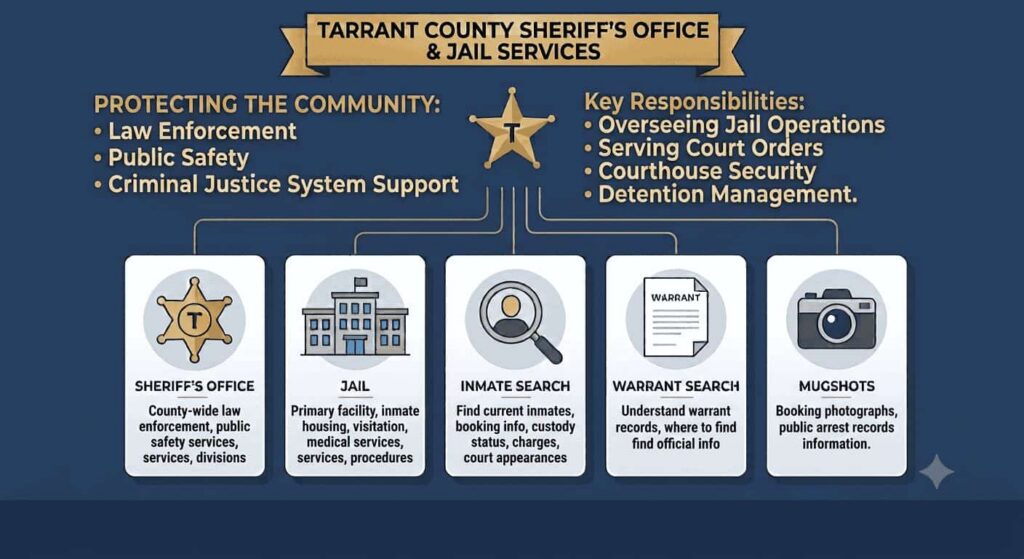
The Tarrant County Sheriff’s Office helps protect the community by providing law enforcement services and supporting the county’s criminal justice system. In addition to maintaining public safety, the office oversees jail operations, serves court orders, provides courthouse security, and manages several detention-related responsibilities. Many residents and visitors use these services to find inmate information, review warrant records, or learn more about county corrections. The sections below introduce each service and link to dedicated pages with complete details.
| Need Information About | Dedicated Page |
|---|---|
| Law enforcement services | Sheriff’s Office |
| Jail operations and visitation | Jail |
| Current inmate information | Inmate Search |
| Active warrant records | Warrant Search |
| Arrest booking photographs | Mugshots |
Sheriff’s Office
The Tarrant County Sheriff’s Office is responsible for county-wide law enforcement duties and public safety services. It supports the courts, manages county detention facilities, serves legal documents, and works with local, state, and federal agencies to help maintain order throughout the county. Visitors can learn more about its divisions, responsibilities, and public services on the dedicated Sheriff’s Office page.
Jail
The Tarrant County Jail is the county’s primary detention facility for individuals awaiting court appearances or serving eligible sentences. The facility oversees inmate housing, visitation, medical services, and daily correctional operations under the supervision of the Sheriff’s Office. More detailed information about jail procedures and available inmate services is provided on the dedicated Jail page.
Inmate Search
The Tarrant County Inmate Search helps users locate publicly available information about individuals currently held in the county jail. Available records may include booking information, custody status, housing location, charges, and scheduled court appearances, depending on public record availability. Users looking for search instructions and inmate-related resources can continue to the dedicated page.
Warrant Search
The Tarrant County Warrant Search introduces warrant records that may be available through the appropriate county offices. This page helps users understand the purpose of warrant records and where to find official information when available. Complete search methods, record availability, and related resources are covered on the dedicated page.
Mugshots
Mugshots are photographs taken during the booking process following an arrest. Depending on Texas law and county policies, some booking photographs may be available as part of public arrest records, while others may have restricted availability. The dedicated Mugshots page explains how these records relate to booking and arrest information.
Vital Records
Tarrant County Vital Records preserve important life events that are officially recorded by authorized government offices. These records include births, deaths, marriages, and divorces, each serving a different legal and administrative purpose. Residents often need these records to verify identity, update legal documents, settle estates, conduct family history research, or complete other official processes. Since each record type is managed differently, this website provides separate pages that explain eligibility, available records, and request information in greater detail.
Types of Vital Records
| Record Type | Common Purpose |
|---|---|
| Marriage Records | Verify a registered marriage |
| Marriage License | Apply before getting married |
| Birth Records | Proof of birth and identity |
| Death Records | Estate and legal matters |
| Divorce Records | Verify a finalized divorce |
Marriage Records & Marriage License
Marriage-related documents serve different purposes. Marriage Records confirm that a marriage has been officially recorded, while a Marriage License is issued before a marriage ceremony takes place. People often need these records for legal matters, family history research, or updating personal documents.
Birth & Death Records
Birth and death records are among the most frequently requested vital records. A birth certificate is commonly used to establish identity, age, or citizenship, while a death certificate may be required for estate administration, insurance claims, or other legal matters. Eligibility to request certified copies depends on Texas law and the type of record requested.
Divorce Records
Divorce Records contain information about divorce cases finalized through the court system. Depending on the record requested, available information may include filing dates, case details, or final judgments. More detailed information about record availability and request options is provided on the dedicated Divorce Records page.
Offices & Government Departments
Tarrant County Offices provide a wide range of public services through specialized county departments and elected officials. These offices oversee official records, court administration, criminal prosecution, election management, and forensic investigations while supporting the daily operations of county government. Residents, businesses, attorneys, and researchers often rely on these departments for official documents, legal records, and government services. The sections below introduce the county offices most frequently used by the public and provide links to dedicated pages with complete information.
| Office | Primary Responsibility |
|---|---|
| County Clerk | Maintains official county records and administrative filings |
| District Clerk | Manages district court records and case administration |
| District Attorney | Prosecutes criminal cases on behalf of the State |
| Medical Examiner | Conducts death investigations and forensic examinations |
| Elections | Administers voter registration and county elections |
County Clerk
The County Clerk maintains many of the county’s official records and supports a variety of administrative services for residents and businesses. This office serves as a central repository for documents filed at the county level and assists with several public record services.
Common responsibilities include:
- Maintaining official county records
- Recording marriage records and assumed names
- Processing public document requests
- Supporting county administrative functions
District Clerk
The District Clerk manages records and documents related to the district courts while supporting court administration throughout the legal process. This office maintains court filings, case records, judgments, and other documents connected with district court proceedings. Visitors looking for court records or case information can find additional details on the dedicated District Clerk page.
District Attorney
The District Attorney represents the State of Texas in criminal cases filed within Tarrant County. Working closely with law enforcement agencies and the courts, this office reviews evidence, prosecutes criminal offenses, and participates in legal proceedings. The dedicated page explains the office’s responsibilities and available public resources.
Medical Examiner
The Medical Examiner investigates deaths that fall under state reporting requirements, including cases involving accidents, violence, or unexplained circumstances. The office performs forensic examinations and prepares official reports that support law enforcement agencies, the courts, and authorized family members when required.
Elections
The Elections Office manages county elections and provides information about voter registration, polling locations, election dates, and voting procedures. Whether residents are preparing to vote or looking for election-related resources, the dedicated Elections page provides detailed information about county election services.
Office Locations & Contact Information
Many county services are provided through different offices located across Tarrant County. The tables below list the primary office locations, phone numbers, and regular business hours for frequently used county departments. Visitors should contact the appropriate office before arriving, as office hours and availability may change during holidays or special circumstances.
Courts & Clerk Offices
Tarrant County’s judicial system includes district, criminal, civil, family, juvenile, probate, and municipal courts. The District Clerk and County Clerk maintain court records, manage filings, and provide public access to legal documents. Contact the respective office for case information, court dates, and filing procedures.
| Office | Official Address | Phone Number | Office Hours |
|---|---|---|---|
| District Court (Civil) | Tom Vandergriff Civil Courts Building, 100 N. Calhoun St., 2nd Floor, Fort Worth, TX 76196 | (817) 884-1574 | Mon–Fri, 8:00 AM–5:00 PM |
| Criminal Court | Tim Curry Criminal Justice Center, 401 W. Belknap St., Fort Worth, TX 76196 | (817) 884-3857 | Mon–Fri, 8:00 AM–5:00 PM |
| Family Court | Family Law Center, 200 E. Weatherford St., 3rd Floor, Fort Worth, TX 76196 | (817) 884-1265 | Mon–Fri, 8:00 AM–5:00 PM |
| Juvenile Court | Scott D. Moore Juvenile Justice Center, 2701 Kimbo Rd., East Building, Fort Worth, TX 76111 | (817) 838-4645 | Mon–Fri, 8:00 AM–5:00 PM |
| Probate Court | Tarrant County Courthouse, 100 W. Weatherford St., Rm 233, Fort Worth, TX 76196 | (817) 884-1415 | Mon–Fri, 8:00 AM–5:00 PM |
| Municipal Court | Varies by City (Fort Worth: 1000 Throckmorton St, Fort Worth, TX 76102) | (817) 392-6700 | Varies by City |
| Justice of the Peace | Multiple Precincts (Main: 100 E. Weatherford St, Fort Worth, TX 76196) | (817) 884-1395 | Mon–Fri, 8:00 AM–5:00 PM |
| District Clerk | 401 W. Belknap St., Fort Worth, TX 76196 | (817) 884-1574 | Mon–Fri, 8:00 AM–5:00 PM |
| County Clerk | 100 W. Weatherford St., Room 130, Fort Worth, TX 76196 | (817) 884-1195 | Mon–Fri, 8:00 AM–5:00 PM |
| District Attorney | 401 W. Belknap St., Fort Worth, TX 76196 | (817) 884-1400 | Mon–Fri, 8:00 AM–5:00 PM |
| Second Court of Appeals | 401 W. Belknap St., Suite 9000, Fort Worth, TX 76196 | (817) 884-1900 | Mon–Fri, 8:00 AM–5:00 PM |
Property Cluster
Property-related services in Tarrant County are handled by the Tax Assessor-Collector for tax payments and the Appraisal District (TAD) for property valuations. Use these offices to search property records, pay taxes, apply for homestead exemptions, or dispute property assessments.
| Office | Official Address | Phone Number | Office Hours |
|---|---|---|---|
| Tax Assessor-Collector | 100 E. Weatherford St., Fort Worth, TX 76196 | (817) 884-1100 | Mon–Fri, 8:00 AM–4:30 PM |
| Appraisal District (TAD) | 2500 Museum Way, Fort Worth, TX 76107 | (817) 284-0024 | Mon–Fri, 8:00 AM–5:00 PM |
| Property Search/Tax | 100 E. Weatherford St., Fort Worth, TX 76196 | (817) 884-1100 | Mon–Fri, 8:00 AM–4:30 PM |
Law Enforcement
The Tarrant County Sheriff’s Office is responsible for law enforcement, operating the county jail, and executing warrants. For inmate information, bond details, warrant searches, or to report non-emergency concerns, contact the appropriate office below. For emergencies, always call 911.
| Office | Official Address | Phone Number | Office Hours |
|---|---|---|---|
| Sheriff’s Office | 200 Taylor St., 7th Floor, Fort Worth, TX 76102 | (817) 884-1213 | Mon–Fri, 8:00 AM–5:00 PM |
| Tarrant County Jail | 100 Lamar St., Fort Worth, TX 76196 | (817) 884-3000 | Open 24 Hours |
| Warrant Search | 200 Taylor St., Fort Worth, TX 76102 | (817) 884-1320 | Mon–Fri, 8:00 AM–5:00 PM |
Vital Records & Others
Vital records including birth certificates, death certificates, marriage licenses, and divorce decrees are available through designated county offices. Additional services include the Medical Examiner for death investigations and the Elections Department for voter registration and election information.
| Office | Official Address | Phone Number | Office Hours |
|---|---|---|---|
| Vital Records (Birth/Death) | 100 W. Weatherford St., Suite B20, Fort Worth, TX 76196 | (817) 884-1550 | Mon–Fri, 8:00 AM–5:00 PM |
| Marriage License | 100 W. Weatherford St., Suite B20, Fort Worth, TX 76196 | (817) 884-1550 | Mon–Fri, 8:00 AM–5:00 PM |
| Divorce Records | 401 W. Belknap St., Fort Worth, TX 76196 | (817) 884-1574 | Mon–Fri, 8:00 AM–5:00 PM |
| Medical Examiner | 200 Feliks Gwozdz Pl., Fort Worth, TX 76104 | (817) 920-5700 | Mon–Fri, 8:00 AM–5:00 PM |
| Elections Department | 2700 Premier St., Fort Worth, TX 76111 | (817) 831-8683 | Mon–Fri, 8:00 AM–5:00 PM |
Frequently Asked Questions
Many visitors have questions about county services, public records, courts, property information, and government offices. The answers below provide a brief explanation of some of the most commonly searched topics. Each response gives a general overview without covering the complete process, helping visitors quickly identify the correct resource before exploring the dedicated page for more detailed information.
What is Tarrant County known for?
The county is recognized for its extensive court system, public records, local government offices, property services, and law enforcement agencies. It serves one of the largest populations in Texas and provides a wide range of services through specialized departments. Residents and businesses frequently rely on these offices for legal records, tax information, elections, and vital records. This website brings these resources together in one place to make navigation easier. Visit the relevant section to explore a specific county service in more detail.
How can I access public records?
Public records are maintained by different county departments based on the type of information requested. Available records may include court documents, property information, marriage records, and other official files that are open under applicable laws. Some records are available online, while others may require a formal request through the responsible office. Record availability depends on legal restrictions and the department that maintains the information. The Public Records page explains each record category and related resources in greater detail.
Where can I search court records?
Court records are maintained by the appropriate court or clerk’s office and may include case filings, hearing schedules, judgments, and other legal documents. The type of information available depends on the court division and applicable public record laws. Separate resources are available for civil, criminal, family, probate, and other court records. This website provides an overview of these records while directing visitors to more detailed information. Visit the Court Records page to explore available record resources.
How do I find property records?
Property records contain information about ownership, recorded deeds, land descriptions, appraisal details, and related real estate documents. These records are commonly used by homeowners, buyers, businesses, and researchers when reviewing property information. Different county offices manage property searches, tax information, and appraisal records. Knowing which office maintains a specific record can make the search process easier. The Property Records page provides detailed information about each property-related service.
How can I search for an inmate in the county jail?
Information about individuals housed in the county jail may be available through the official inmate search system. Depending on public record availability, search results can include booking details, custody status, housing location, charges, and scheduled court appearances. Jail records are maintained as part of the county’s detention and corrections services. This website provides a general introduction while directing users to more detailed inmate resources. Visit the Inmate Search page for complete information and related jail services.