
Tarrant County Arrest Records contain official information created after a person is taken into custody by a law enforcement agency within the county. These arrest records document the details of an arrest and may be available for public inspection, subject to Texas law. An arrest record identifies the event of an arrest, but it does not determine whether a person is guilty of a crime. A conviction can only result from a court proceeding after the legal process is completed. This distinction helps users review arrest information with the correct legal context before relying on the record for personal or professional purposes.
Tarrant County Arrest Records may include booking records, detention details, the arrest date, booking date, reported charges, booking number, arresting agency, and current custody records when those details are available for public release. The amount of information shown depends on the type of record and any legal restrictions that apply. Some records remain unavailable if they have been sealed, expunged, or involve juvenile matters protected by law. This page explains how public arrest records are maintained, what information they commonly contain, and the available options for reviewing official arrest documentation through authorized record sources.
Search Tarrant County Arrest Records
The official arrest lookup system allows users to search publicly available arrest records using basic identifying information. In Tarrant Count entering accurate search details helps locate the correct record more efficiently and reduces unrelated results.
Open the Search Portal
Visit the official arrest records search portal: https://inmatesearch.tarrantcounty.com
Select a Search Method
Choose one of the available search options.
- Search by Name
- Search by CID (Booking Number)
The current system does not include dedicated search fields for Arrest Date or Booking Date.
Enter the Available Information
Complete one or more search fields.
| Search Field | Purpose |
|---|---|
| Last Name | Locate records by surname |
| First Name | Narrow search results |
| CID | Search using the booking identification number |
| Race (Optional) | Filter matching records |
| Sex (Optional) | Filter matching records |
Run the Search
Select Search to display matching records. If multiple records are returned, optional filters can help narrow the results.
Review the Results
Select the appropriate record from the results list. If no match appears, verify the search information and try another search using fewer details or a different search method.
Information Found in Arrest Records
Arrest records contain identifying details recorded during the booking process after an arrest. The exact arrest information available depends on the law enforcement agency, the type of case, and any legal restrictions. Reviewing these details helps users confirm they have located the correct record before requesting copies or reviewing additional case information.
The table below summarizes the information commonly available in public arrest records.
| Information | Description |
|---|---|
| Name | Full name of the person listed in the arrest record. |
| Booking Number | A unique identification number assigned during the booking process. |
| Arrest Date | The date the individual was taken into custody by law enforcement. |
| Booking Date | The date the individual was officially processed into the record system. |
| Arresting Agency | The law enforcement agency responsible for making the arrest. |
| Charges | Reported criminal charges associated with the arrest at the time of booking. |
| Custody Status | Indicates whether the person is currently in custody or has been released, when publicly available. |
Types of Arrest Records
Arrest records are grouped into different categories based on the person’s age, the classification of the alleged offense, or the time the arrest occurred. Each category helps distinguish one type of record from another and provides a clearer picture of how arrest information is organized by law enforcement agencies. Identifying the correct record type can help users understand which category applies to the arrest they are reviewing.
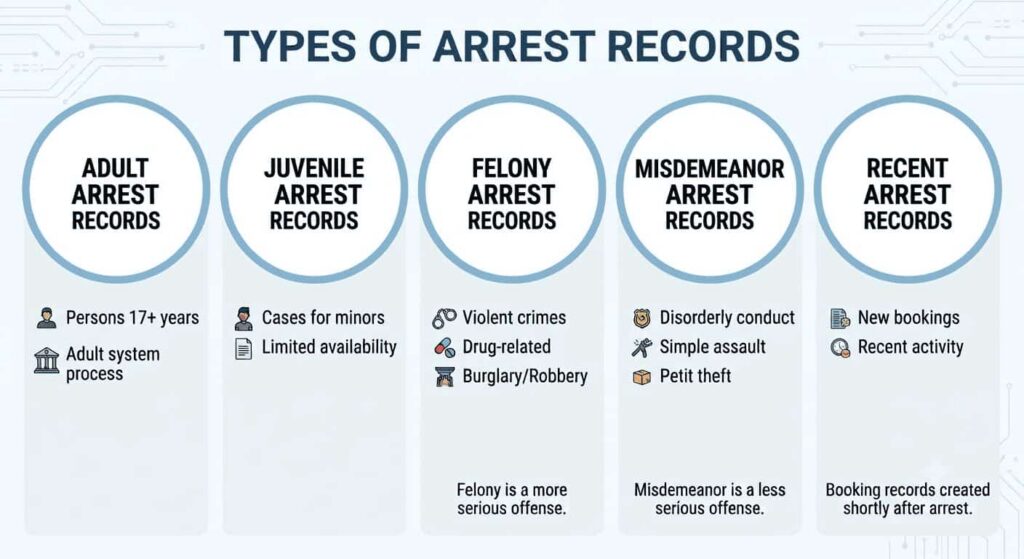
Adult Arrest Records
Adult arrest records relate to arrests involving persons who are legally recognized as adults under Texas law. These records are created after an adult has been taken into custody and processed by the appropriate law enforcement agency. They form part of the official arrest documentation maintained by the responsible record custodian.
Adult arrest records commonly involve:
- Persons 17 years of age or older under Texas criminal law
- Arrests made by county or local law enforcement agencies
- Felony or misdemeanor allegations
- Arrests handled through the adult criminal justice system
Juvenile Arrest Records
Juvenile arrest records involve arrests of minors whose cases are handled through the juvenile justice system. Unlike adult records, the availability of these records is limited by Texas law. Public availability depends on the type of case and the legal authority governing juvenile proceedings.
Juvenile arrest records generally relate to:
- Individuals below the age handled in adult criminal court
- Juvenile delinquency matters
- Youth-related criminal allegations
- Proceedings managed through the juvenile justice system
Felony Arrest Records
Felony arrest records relate to arrests involving offenses classified as felonies under Texas law. A felony is generally considered a more serious criminal offense and may carry greater legal penalties if a conviction occurs. An arrest record simply documents that an arrest took place and does not indicate the outcome of any court proceedings.
Felony arrests may involve allegations such as:
- Violent offenses
- Drug-related offenses
- Burglary
- Robbery
- Other felony-level crimes
Misdemeanor Arrest Records
Misdemeanor arrest records relate to arrests involving offenses classified as misdemeanors. These records document arrests for criminal offenses that are generally less serious than felonies. The classification of an offense is determined by Texas law and does not reflect the final outcome of a criminal case.
Common misdemeanor arrests may involve:
- Disorderly conduct
- Simple assault
- Theft involving lower-value property
- Criminal trespass
- Certain traffic-related criminal offenses
Recent Arrest Records
Recent arrest records include booking records created shortly after an arrest has been completed. These records represent the latest booking activity entered into the official records system and may be updated as additional information becomes available through the normal record management process.
Recent arrest records often relate to:
- Newly processed bookings
- Recent law enforcement activity
- Newly entered arrest documentation
- Recently recorded custody events
Arrest Reports
Arrest reports are official documents prepared by the arresting law enforcement officer at the time of an arrest. They provide a written account of the circumstances surrounding the arrest and become part of the official documentation created during the arrest process. An arrest report records the events that led to the arrest, whereas an arrest record serves as a summary of the booking and custody information maintained by the appropriate record custodian.
Although the two terms are often used interchangeably, an arrest report and an arrest record serve different purposes. Knowing the difference helps users identify the type of document they need before submitting a record request.
| Arrest Record | Arrest Report |
|---|---|
| Created after a person is booked into custody. | Prepared by the arresting officer during the arrest process. |
| Primarily documents the official booking of an individual. | Describes the events and circumstances that led to the arrest. |
| Used as part of the official arrest record maintained by the record custodian. | Becomes part of the official documentation related to the arrest. |
| Focuses on booking and custody status. | Focuses on the incident that resulted in the arrest. |
An arrest record and an arrest report are related documents, yet they serve different purposes within the criminal justice process. Identifying the correct document type before making a request can help users obtain the information they are seeking more efficiently.
Public Access and Restricted Arrest Records
Many arrest records are available for public inspection under Texas law, while others may have limited availability based on legal requirements or court action. Whether a record can be viewed depends on the type of record, the age of the person involved, and any restrictions established by law. Before reviewing an arrest record, users should understand which records are publicly available and which may have restricted visibility.
Public Arrest Records
Many adult arrest records are available to the public through official record custodians. Publicly available records may include arrests handled by county or local law enforcement agencies, provided no legal restriction applies.
Public availability commonly depends on:
- The type of arrest record
- Applicable Texas laws
- Court orders affecting the record
- The status of the record
Sealed Records
A sealed arrest record is removed from general public view by a court order. Once a record has been sealed, it is no longer available through standard public record searches. Access to these records is limited to persons or agencies authorized by law.
Juvenile Arrest Records
The availability of juvenile arrest records is more limited than adult arrest records. Many records involving minors are not included in public record systems and may only be available to persons or agencies authorized under Texas law.
Expunged Arrests
An expunged arrest is removed from public records after an expunction has been granted under Texas law. Once the process is complete, the arrest record is generally no longer available through standard public record searches maintained by public record custodians.
Request Arrest Record Copies
Copies of arrest records may be requested through the appropriate law enforcement agency using several submission methods. The available request option often depends on the agency maintaining the record and the type of document requested. Providing complete record details with the request can help staff locate the correct record more efficiently.
Request Copies Online
Many agencies provide an online request option for eligible public records. Users can complete the required request form, enter the available record information, and submit the request electronically through the official records portal.
Before submitting an online request, it is helpful to have:
- Full name of the person listed in the record
- Booking number, if available
- Arrest date or approximate date
- Name of the arresting agency
Request Copies by Mail
Users who prefer a paper request may submit a written request by mail to the appropriate records office. Including complete identifying information helps the records office locate the correct document and reduces the possibility of delays caused by incomplete requests.
A mailed request should include:
- Requester’s contact information
- Name of the person listed in the record
- Booking number, if known
- Arrest date or approximate date
- Description of the record being requested
Request Copies in Person
Arrest record copies may also be requested by visiting the appropriate records office during normal business hours. Staff can assist with locating the requested record after receiving the available identifying information.
When visiting in person, users should be prepared to provide:
- Name of the person listed in the record
- Booking number, if available
- Arrest date or approximate date
- A valid government-issued photo ID, if required by the records office
Fees and Processing Time
The cost of obtaining arrest record copies depends on the type of record requested and whether certification is required. Processing time varies based on record availability, request volume, and the nature of the requested documents. Reviewing the applicable fees before submitting a request can help users prepare for the record request process.
Copy and Certification Fees
| Service | Fee |
|---|---|
| Standard Arrest Record Copy | Varies by record type |
| Certified Copy (If Available) | Additional certification fee may apply |
| Records Research (When Required) | Additional fee may apply |
Fees are determined by the agency maintaining the requested record. Users should confirm current charges before submitting a request.
Accepted Payment Methods
The available payment options depend on the records office handling the request. Commonly accepted payment methods include:
- Credit card
- Debit card
- Cash (for in-person transactions, where accepted)
- Money order
- Cashier’s check
Processing Time
Processing time depends on several factors, including the availability of the requested record and the current workload of the records office.
The amount of time required may vary based on:
- Whether the record is immediately available
- The age of the requested record
- The number of records requested
- Current request volume
Simple requests may be completed sooner than requests involving archived or older records. Users needing records for legal or time-sensitive purposes should allow sufficient processing time before their required deadline.
Difference Between Arrest Records and Criminal Records
An arrest record and a criminal record are related, but they are not the same. An arrest record documents that a person was taken into custody by a law enforcement agency, whereas a criminal record reflects a person’s involvement in the criminal justice system and may include court proceedings and case outcomes. Knowing the difference helps users identify the type of record they need before beginning a search.
The table below highlights the key differences between these two types of records.
| Arrest Record | Criminal Record |
|---|---|
| Created after a person is arrested and booked. | Includes information from criminal court proceedings. |
| Documents an arrest event. | May include arrests, charges, court actions, and convictions. |
| Does not establish guilt or innocence. | May show convictions, dismissals, acquittals, or sentencing outcomes. |
| Often contains booking information and arrest details. | Provides a broader criminal history maintained through the justice system. |
| Prepared during the arrest and booking process. | Updated as a criminal case moves through the courts. |
Why an Arrest Record May Not Be Available
An arrest record may not always appear during a search, even when an arrest has occurred. Several factors can affect record availability, including record status, legal restrictions, and the search information entered. Knowing these situations can help users understand why a record may not be found.
Record Has Not Been Indexed
Recently created arrest records may require time before they appear in the official records system. If the record has not yet been indexed or updated, it may not be available immediately after the arrest.
Sealed Record
A record that has been sealed is removed from standard public record systems. Since sealed records are no longer available for general public viewing, they may not appear during a public search.
Juvenile Arrest Record
Many juvenile arrest records are not included in public record systems. Their availability is limited under Texas law, which means they may not appear in standard public searches.
Expunged Arrest
An expunged arrest record is removed from public records after an expunction has been granted. Once the process is complete, the record generally no longer appears in public search systems.
Incorrect Search Information
Search results depend on the accuracy of the information entered. A record may not be found if the search contains incorrect or incomplete details, such as:
- Misspelled name
- Incorrect booking number
- Wrong arrest date
- Incomplete identifying information
Location
Arrest records are maintained by the law enforcement agency responsible for making the arrest. The agency that creates the record serves as the official record custodian and maintains the records in accordance with Texas law. Identifying the correct office can help users contact the appropriate agency for arrest record information.
| Office / Department | Location | Phone Number |
|---|---|---|
| Sheriff’s Office Administration | 200 Taylor Street, 7th Floor, Fort Worth, TX 76196 | (817) 884-3099 |
| Sheriff’s Office Records Division | 200 Taylor Street, Fort Worth, TX 76196 | (817) 884-2942 |
| Non-Emergency Dispatch | N/A (Phone Only) | (817) 884-1213 |
| Emergency | N/A (Phone Only) | 9 – 1 – 1 |
Frequently Asked Questions
The following questions answer common concerns about arrest records, record searches, public availability, and obtaining official copies. These responses provide helpful information for users seeking arrest-related records while avoiding confusion with other public record types.
How do I search arrest records in Tarrant County?
Arrest records can be searched through the official online lookup system provided by the Tarrant County Sheriff’s Office. Users can search using a person’s name or a booking number, depending on the information available. Entering accurate details helps narrow the search results and locate the correct record more efficiently. If multiple records appear, additional identifying information can help distinguish between individuals with similar names.
Are arrest records available to the public?
Many adult arrest records are available for public inspection under Texas law. Public availability depends on the legal status of the record and the type of case involved. Some records may not appear in public searches if they have been sealed by a court, expunged under state law, or involve juvenile matters. The amount of information available may vary based on applicable legal requirements.
Can I search arrest records using a booking number?
Yes. A booking number is one of the most accurate ways to locate an arrest record because it is assigned to a specific booking event. Entering the correct booking number usually reduces unrelated search results and helps identify the correct record more quickly. If the booking number is unavailable, users may search using the person’s name through the official lookup system.
What information is typically included in an arrest record?
An arrest record commonly includes the person’s name, booking number, arrest date, booking date, arresting agency, reported charges, and custody status when that information is available for public release. The exact details shown may differ depending on the agency maintaining the record and any legal restrictions that apply. An arrest record documents an arrest event and should not be interpreted as proof of guilt or a criminal conviction.
How can I obtain a copy of an arrest record?
Copies of arrest records may be obtained through the law enforcement agency that maintains the record. Requests can usually be submitted online, by mail, or in person, depending on the available services offered by the records office. Providing complete identifying information, such as the person’s name, booking number, or arrest date, helps staff locate the requested record more efficiently and reduces unnecessary delays.